AI models find the errors human peer reviewers miss
AI models find the errors human peer reviewers miss
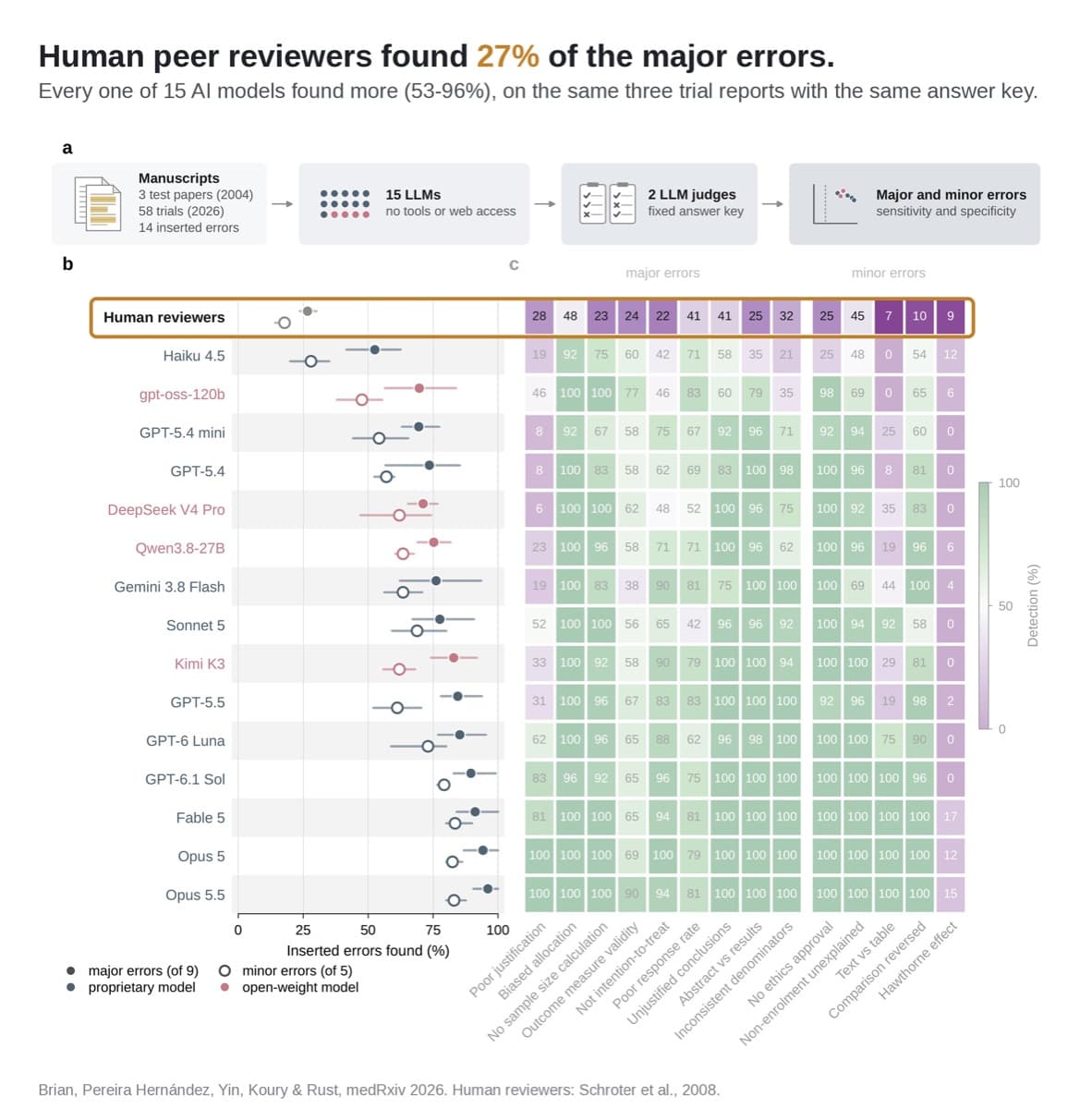
Human peer reviewers found 27% of the major errors planted in three trial reports. All 15 AI models tested found more, from 53% to 96%.
Links
- Preprint: Large language models detect methodological errors that human peer review misses in clinical trials, medRxiv, 28 Oct 2026
- X summary: https://x.com/i/trending/2115860808865587425 ("AI Outspots Human Errors in Science Reviews But Quietly Shapes Judgments")
Overview
The human baseline is a 2008 study (Schroter et al.) that planted errors in three randomised trial reports and sent them to reviewers. They found 27% of the major errors on average. The authors gave the same three reports to 15 models with no tools or web access, then scored the reviews with two AI judges and a fixed answer key.
- Original reports: models found 53% to 96% of major errors.
- New trials: to rule out memorisation, they repeated it on 58 trials published in 2026. Models found 58% to 99%; open-weight models 66% to 89%.
- Best: Opus 5.5, at 99% on the 2026 trials. GPT-6.1 Sol (94%) and GPT-6 Luna (86%) are named as cheaper options.
- Speed: 1.4 to 16 minutes per review, against the 5 to 8.5 hours human reviewers report.
- False alarms: on unmodified reports, models still flagged 14% to 29% of the error types, most often "conclusions not supported by results".
The authors' caveats: the human comparison is historical, and no humans reviewed the 2026 trials. AI judges scored the reviews. Four of the five authors work with ResearchHub Foundation, which is building AI-assisted review.
Why interesting
It is a clean before-and-after: the same papers and answer key, people in 2008 and models in 2026. Even the weakest model doubled the humans' score. Read it next to Anthropic's study the same week (anthropic-agents-judgment-calls): AI is now better than experts at catching errors, and also good at steering what experts decide.