How work is changing at Anthropic: six agent hours for every human hour
How work is changing at Anthropic: six agent hours for every human hour
Anthropic studied its own staff to see what an AI-saturated workplace looks like. In seven months, the hours worked by staff's agents went from about a tenth of human hours to six times human hours. Output per person rose sharply, junior hiring fell, and people became managers of Claudes.
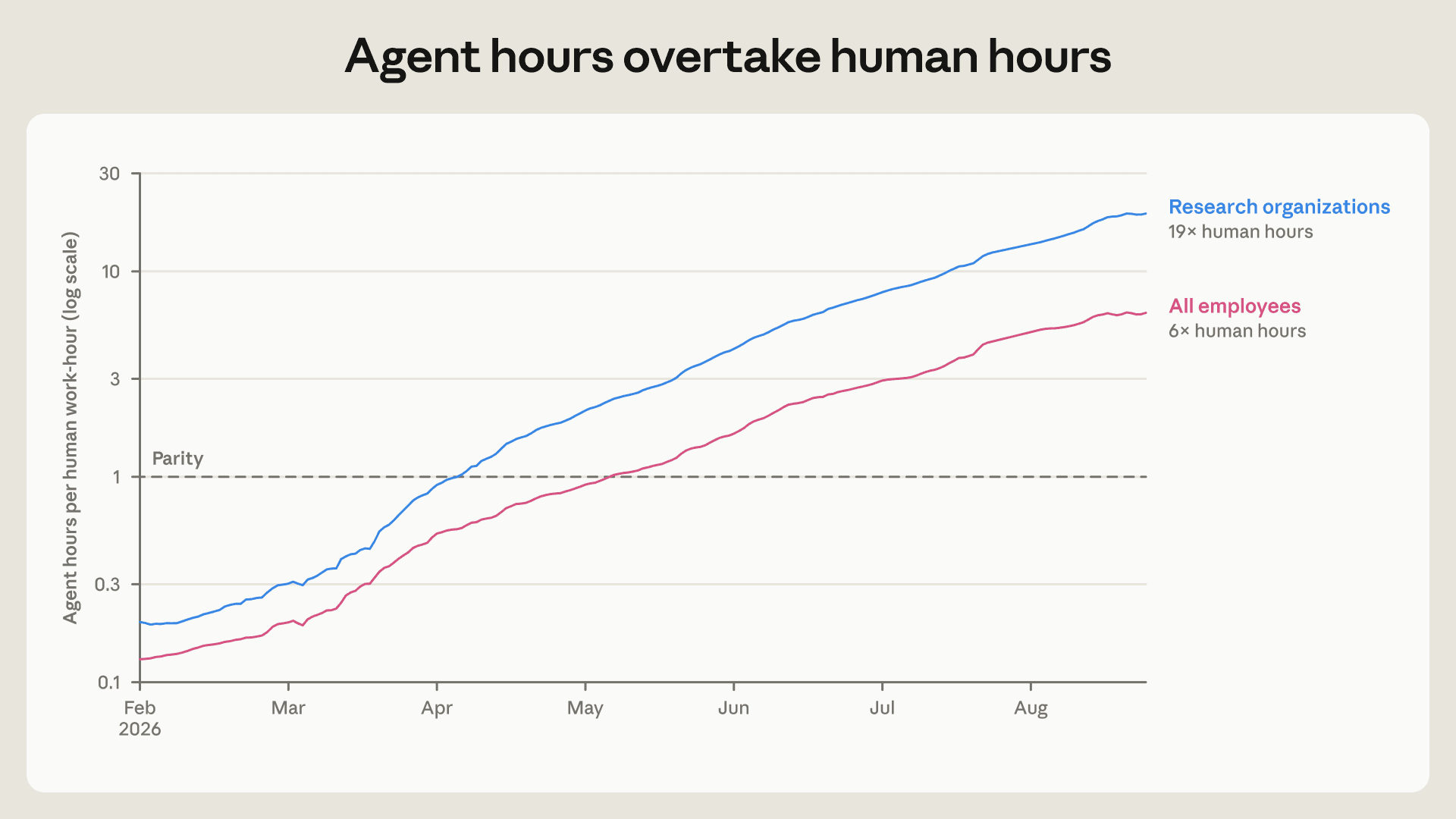
Agents started by staff, per human work-hour: parity in April (research) and May (everyone). Source: Anthropic.
Links
- Report: https://www.anthropic.com/research/employment-at-anthropic (16 Oct 2026)
- Companion piece: "Working at the frontier shapes expectations for the future" (Anthropic, 16 Oct 2026)
- Earlier study: How AI is transforming work at Anthropic (Dec 2025)
Overview
Anthropic is a leading indicator: it has rebuilt its workflows around AI faster than almost anyone. The report draws on internal data on headcount, agent use, output, surveys, calendars, Slack and hiring scorecards, plus 17 interviews.
The headline is the speed. In February 2026, staff's agents worked about a tenth as many hours as the staff did. By August they worked six times as many. In research teams it went from a fifth to 19 times: nearly 100x in seven months.
| Measure | Then | Now |
|---|---|---|
| Agent hours per human hour, all staff | ~0.13 (Feb 2026) | 6 (Aug 2026) |
| Agent hours per human hour, research teams | ~0.2 (Feb 2026) | 19 (Aug 2026) |
| Code commits per engineer | 1x | 5x (6 months later) |
| Junior share of technical hires | 27% (early 2025) | 9% (2026) |
| Coding sessions per month, non-technical staff | 2 (Aug 2025) | 90 (May 2026) |
| Standing instructions written for agents | a few hundred (Jul 2025) | 8,500 (Jul 2026) |
Source: Anthropic, "How employment is changing at Anthropic".
Productivity rose everywhere
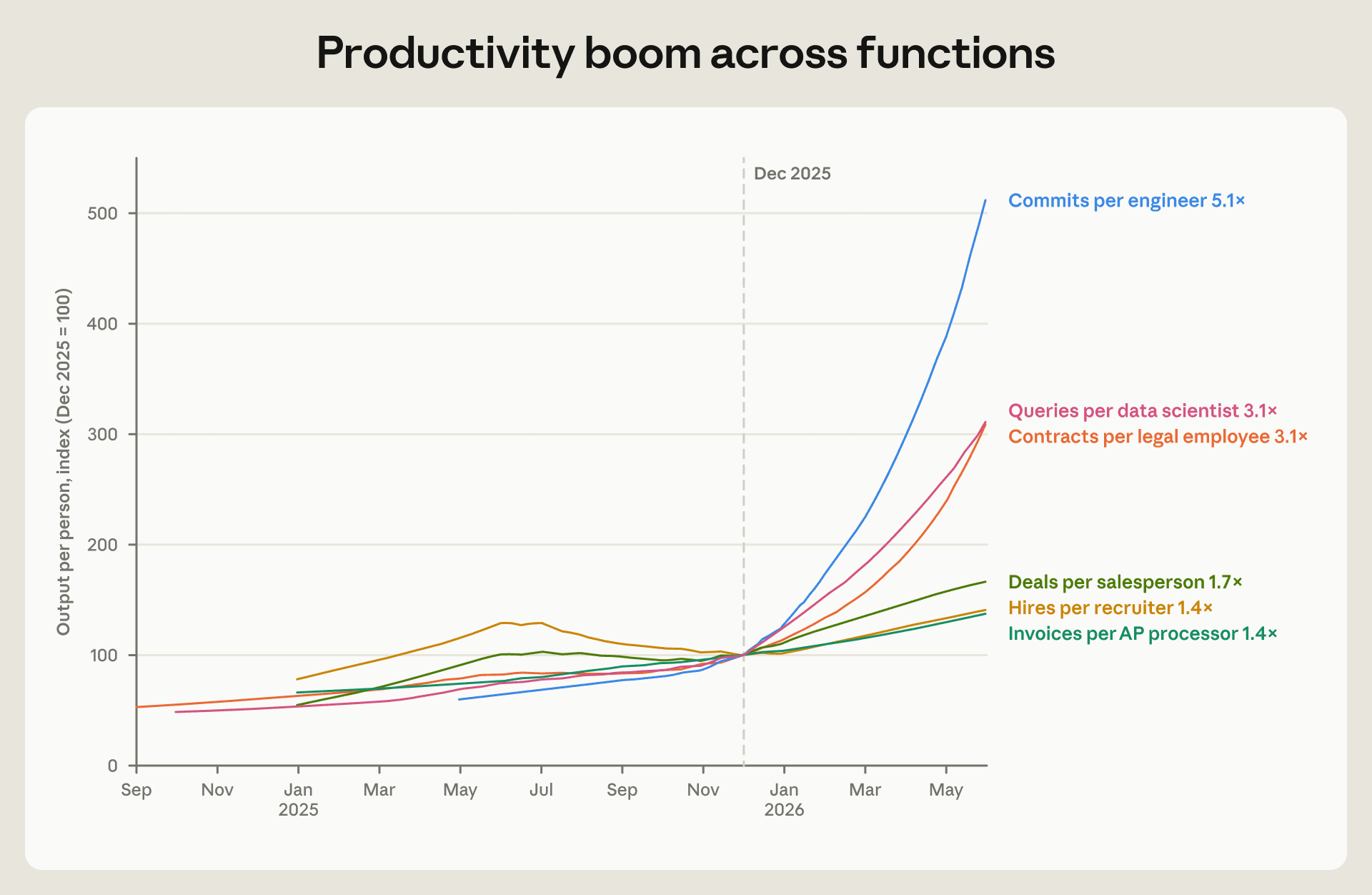
Output rose in every job with measurable output, not just engineering.
Engineers now commit five times as much code as six months ago. Lawyers process more contracts, accounts payable clears more invoices, salespeople close more deals. A sales rep built a custom dashboard in three to four hours: "a build like this was out of my wheelhouse".
To separate AI from Anthropic's fast business growth, the authors followed 192 engineers as they adopted coding agents, against 74 who didn't. Output rose sharply after adoption. They found no sign of "AI slop": agent-written code was removed or reverted no more often than the same person's own code.
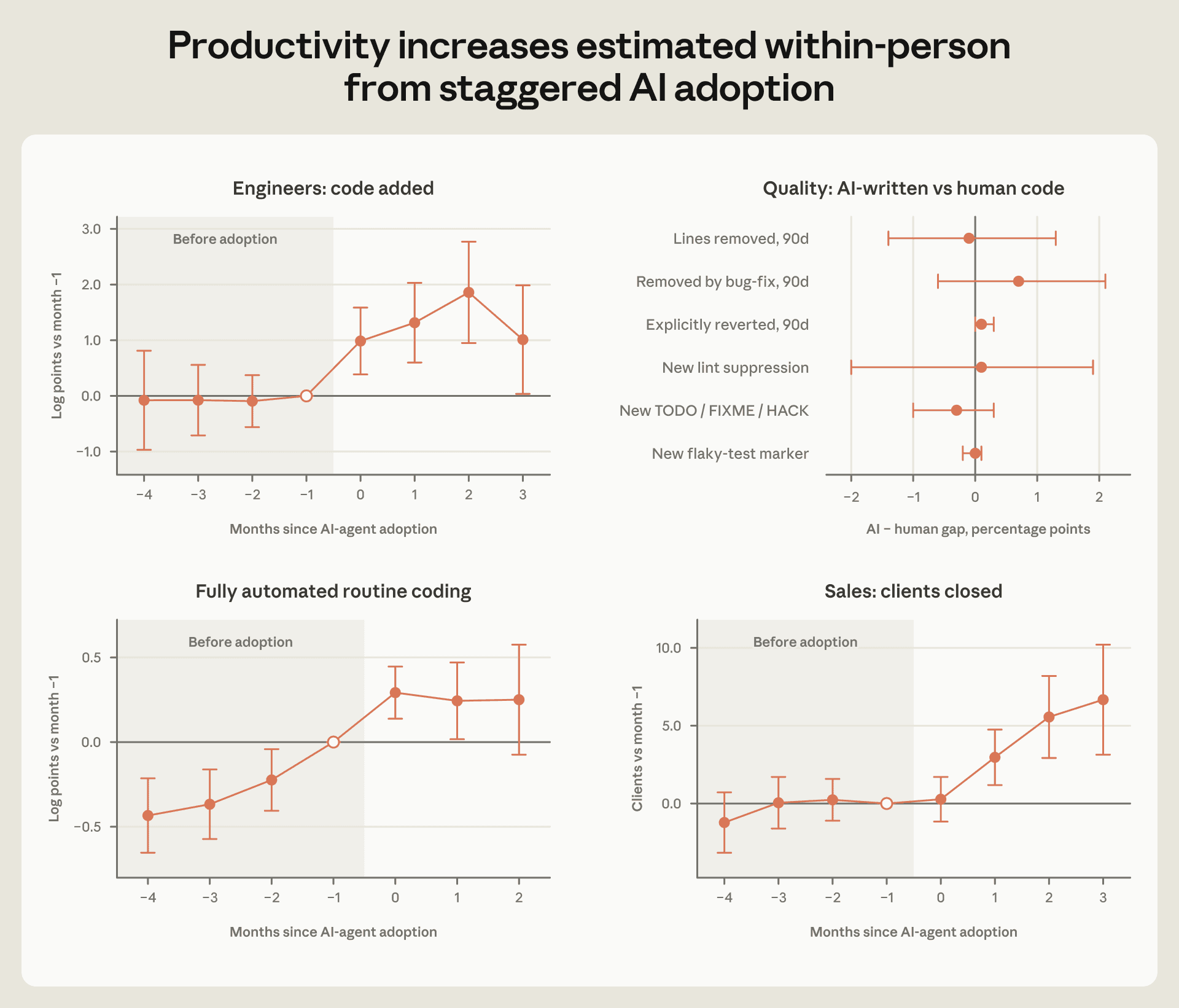
The same person, before and after adopting coding agents. The quality panel compares their own code with their agents' code.
Fewer junior jobs
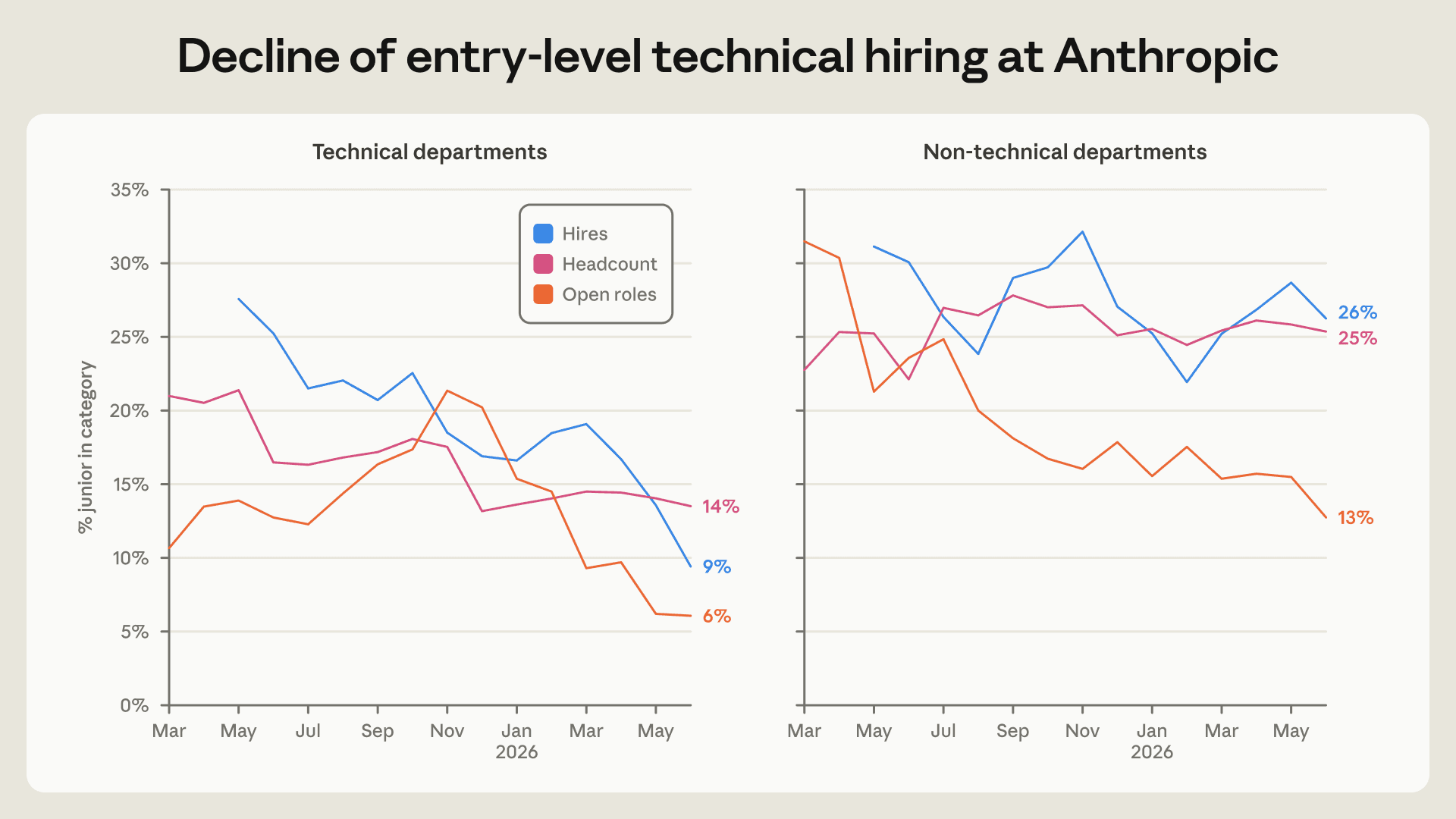
Junior share of technical staff, 21% to 14% since early 2025; of technical hires, 27% to 9%.
The company still grows fast, but hires less per dollar of revenue. At five years old, it makes two to four times the revenue per employee that Google and Meta made at the same age.
From January 2026, teams found Claude could take over much junior coding work. One said a new model "basically overnight changed what we were looking for". By April, a third of ML managers and a fifth of software managers said they were hiring less because of AI.
The drop is steepest in jobs where staff use Claude for the most complex work.
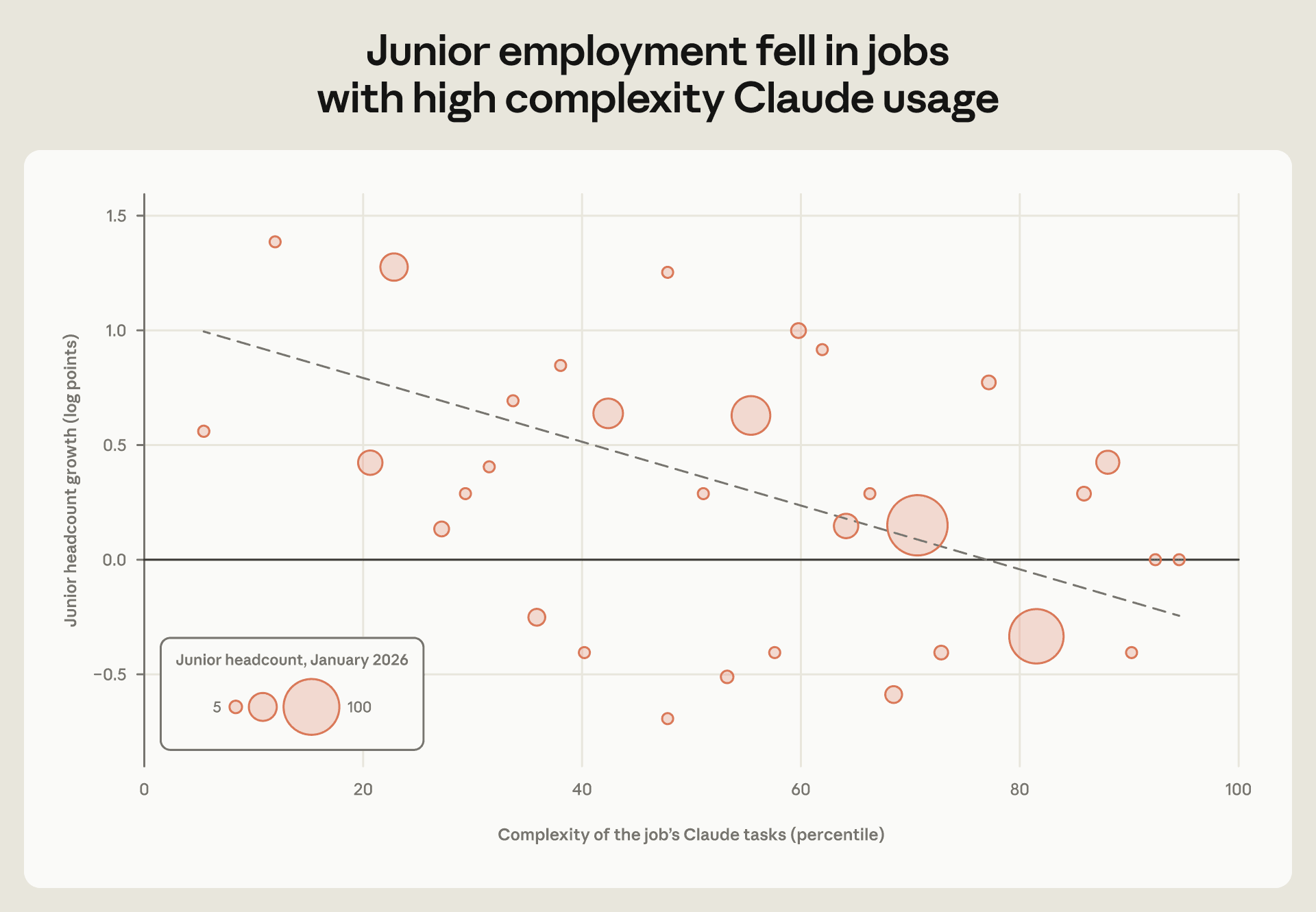
Each dot is a job. The more complex the Claude use, the slower junior hiring grew.
Humans become the bottleneck
Interactive agent sessions spend about 80% of their time waiting for a human. One engineer described "an army of Claudes, with every one asking for my attention", and compared it to babysitting. Simply reading everything Claude writes would take over half the work week, even for non-technical staff.
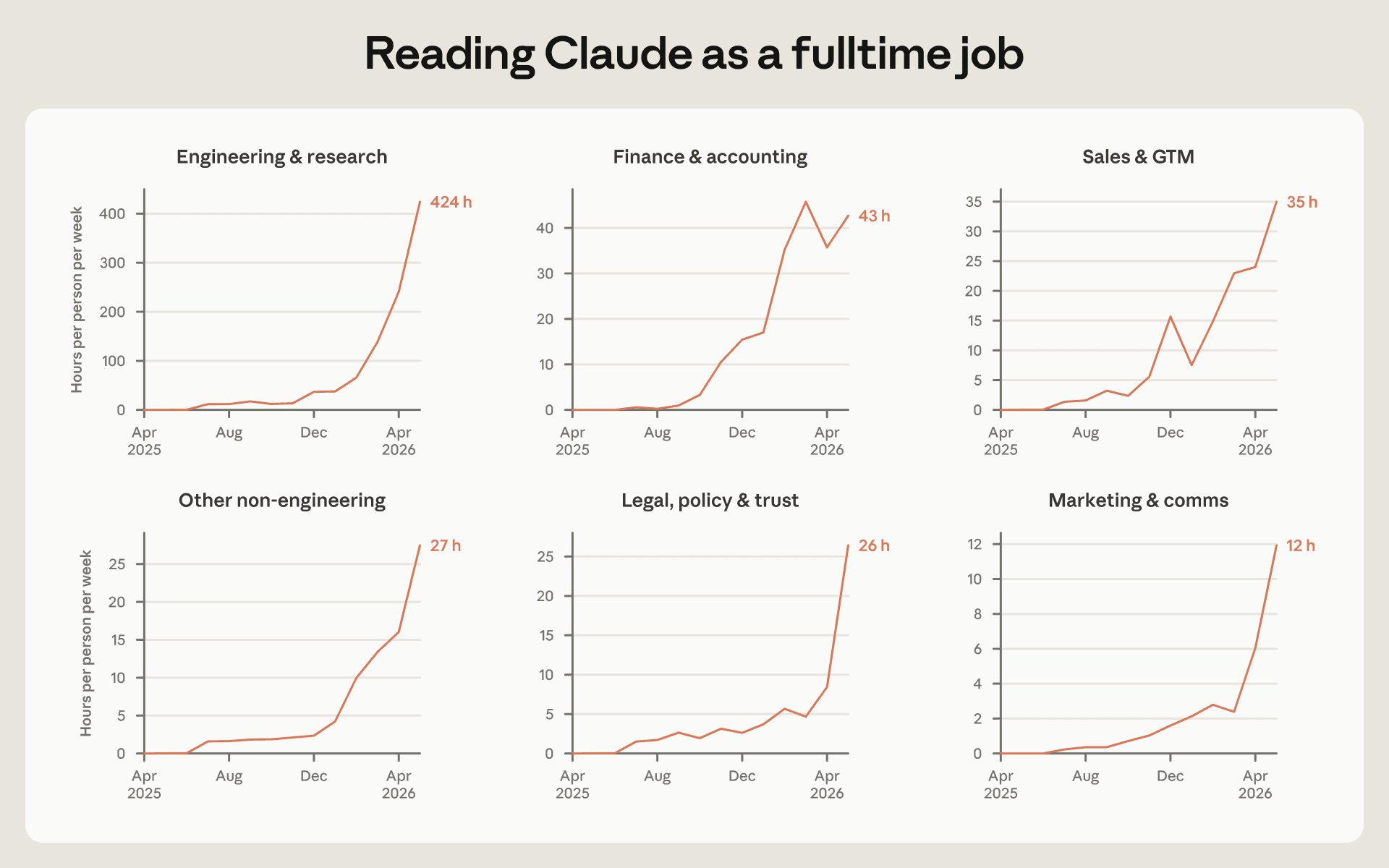
Hours needed to read all Claude output, at 250 words a minute.
So people build tools to manage their agents. This "meta-work" (writing specs, having one agent review another, monitoring pipelines) doubled from 10% to 22% of the average employee's interactive sessions between autumn 2025 and spring 2026. One engineer set up an agent chief of staff to triage requests. Another wrote a performance review for their Claude team.
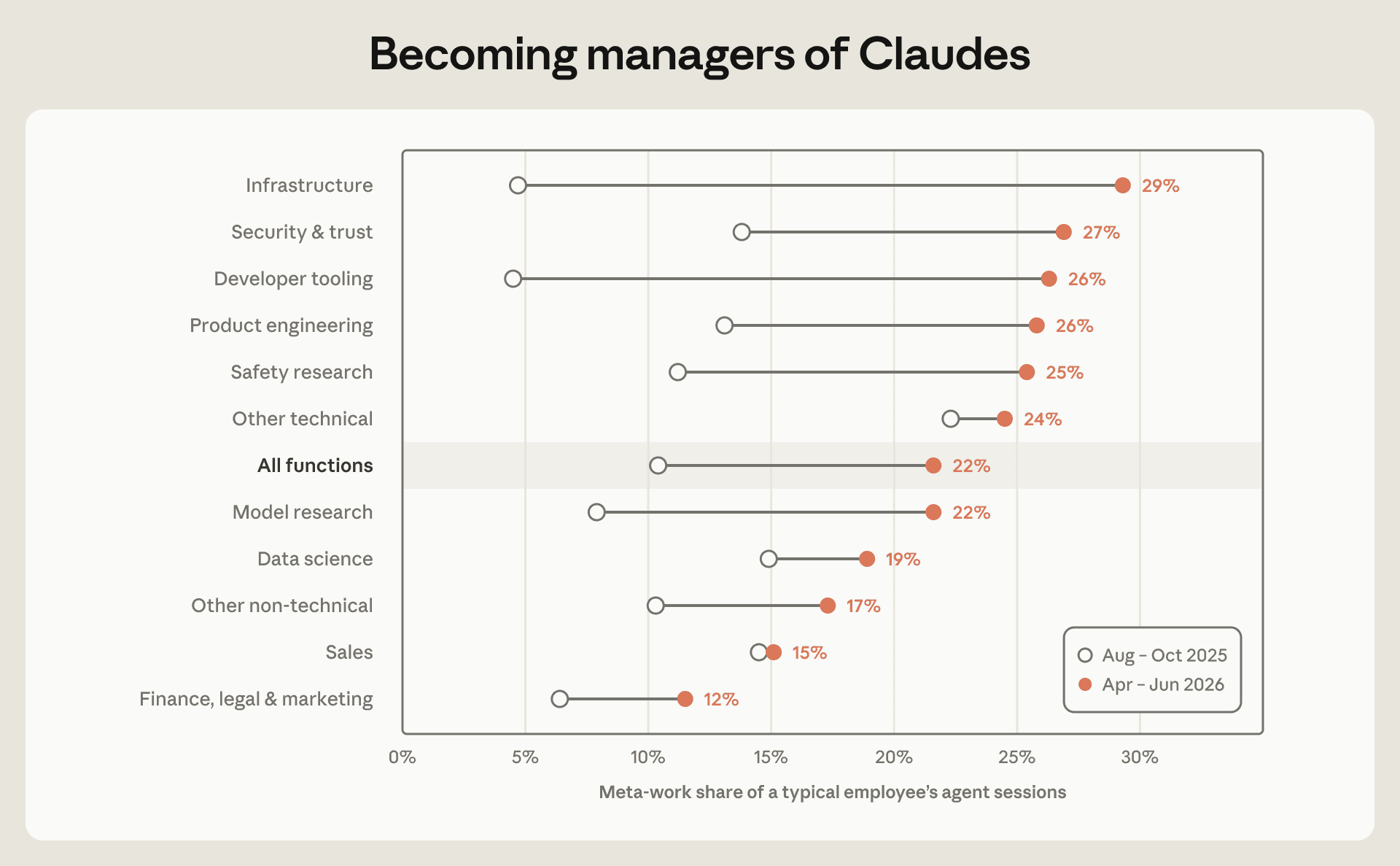
Share of sessions about managing agents rather than doing the work.
What stays human
Meetings are up 20% for the median employee: strategy, judgement and coordination still need people. In non-technical jobs, "that 20% that was strategic becomes 90% of the job". Work has to happen in the open, because agents can't use decisions made in unlogged meetings.
Hiring managers now prize autonomy and judgement over domain expertise. Mentions of candidates' creative AI use have tripled for technical roles and quadrupled for others since 2024.
Anthropic's responses are broad stock ownership, an early warning system for jobs at risk, and moving people between teams: staff with a year's tenure are 50% more likely each month to switch departments than in 2025. The authors admit none of this helps people who are never hired.
Why interesting
- A preview of the future of work. If Anthropic is where other firms are heading, knowledge workers become managers of agent teams, and their attention is the scarce resource.
- The junior-jobs question, with hard data. This is one of the clearest records yet of AI reducing entry-level hiring inside a single firm, from the firm itself.
- Staff expect much more. Employees expect AI to do 75% of their work by 2030, against 28% for other Americans.