AI Futures Project: "the intelligence explosion will happen in 2027 after all"
AI Futures Project: "the intelligence explosion will happen in 2027 after all"
The authors of ai-2027 pulled their forecasts forward in a 10 November 2026 update. All of them now expect a Superhuman AI Researcher (SAR) most likely in 2027, assuming no deliberate slowdown. The single biggest reason, they say, is METR's report on AI R&D acceleration at Anthropic (metr-anthropic-ai-rd-acceleration).
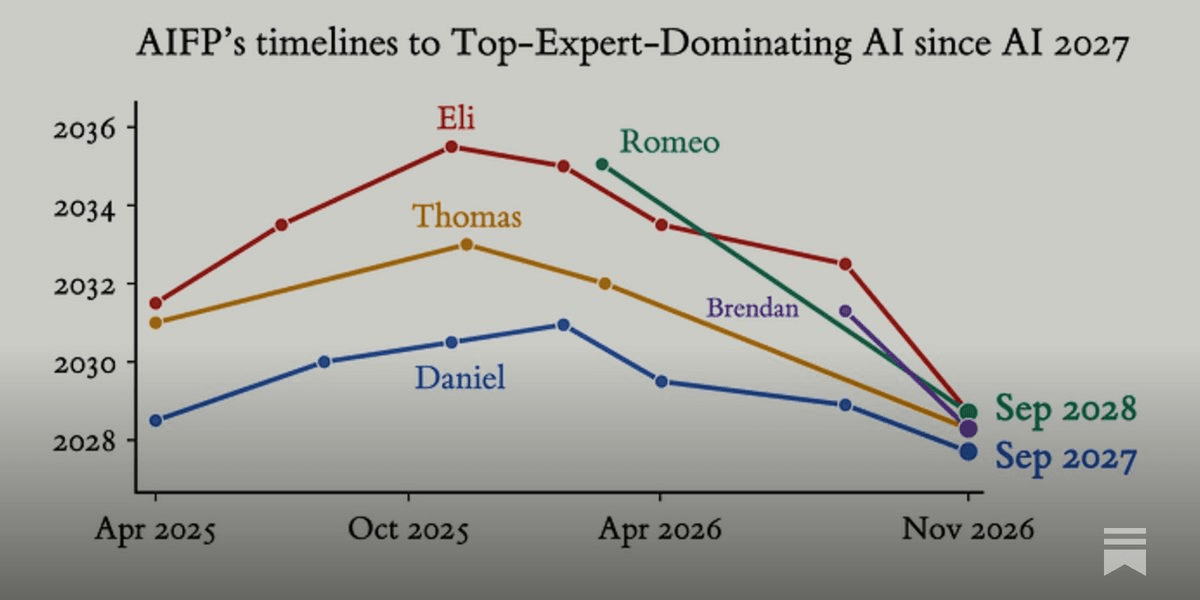 AI Futures Project: each author's median forecast for Top-Expert-Dominating AI (TED-AI) since AI 2027.
Links
- Post: Q3.5 Timelines Update: Looks Like the Intelligence Explosion Will Happen in 2027 After All, AI Futures Project, 10 Nov 2026
- Daniel Kokotajlo's thread: https://x.com/DKokotajlo/status/2120204075803500595
- Buck Shlegeris (Redwood Research): https://x.com/bshlgrs/status/2120271165692461316
- Coverage: Yahoo Tech
- Companion posts: Verified compute allocation disclosures; Pacing AI via compute reallocation
What they say
Kokotajlo on X:
Unfortunately, it seems like the intelligence explosion will be happening in 2027 after all. … If they're right, that implies an AI-driven acceleration that is 5 months ahead of the AI 2027 scenario. I am scared, sad, and angry.
- Headline: SAR likely in 2027; a 35–65% chance of TED-AI before 2028.
- Daniel Kokotajlo: SAR median May 2027 (from December 2028 in August); TED-AI median September 2027.
- Thomas Larsen: TED-AI April 2028, from early 2032.
- Eli Lifland and Romeo Dean: TED-AI around September 2028.
Why they moved
METR estimated Anthropic's progress at about twice its earlier rate, with perhaps 80% of that due to AI. The authors turn that into about a 1.7× AI-driven speed-up and feed it into their model, which before the report gave that level under a 4% chance. They flag two caveats: Anthropic redacted most of the evidence METR found most informative, and the speed-up may hold only for well-specified tasks.
Their conclusion: "If SAR is coming in 2027, it is incredibly urgent to pause or substantially 'pace' frontier AI development." Buck Shlegeris, separately, put about a one-in-three chance on AI companies building superintelligence within a year.